WhatsApp Automation Ideas That Actually Help Indian Businesses Save Time and Close More Sales
Discover practical WhatsApp automation ideas for Indian businesses to automate lead responses, follow-ups, reminders, support, and sales workflows while improving conversions and saving operational time.
Most businesses do not realize how much time they lose every single day inside WhatsApp.
Not because WhatsApp is inefficient.
But because their workflows are.
A sales executive manually replying to the same pricing query fifteen times a day. A founder sending appointment reminders at midnight. A support team copy-pasting payment details repeatedly. A clinic coordinator manually confirming bookings. A consultant forgetting post-demo follow-ups because conversations are scattered across chats, spreadsheets, and notebooks.
Individually, these tasks seem manageable.
Collectively, they drain operational bandwidth, slow response times, and quietly reduce conversions.
And as businesses scale, the problem compounds.
This is exactly why WhatsApp automation is becoming one of the most important operational systems for Indian MSMEs, startups, agencies, consultants, educational institutions, healthcare providers, real estate firms, and service businesses.
But there is one important distinction many businesses still misunderstand:
Good automation does not feel robotic.
It feels fast, contextual, organized, and genuinely helpful.
The businesses seeing the best results today are not the ones sending the highest volume of messages. They are the ones using automation strategically to remove friction from the customer journey while keeping conversations human.
That shift changes everything.
Why WhatsApp Automation Matters More in India
India has become one of the world’s largest conversational business ecosystems.
Customers increasingly expect businesses to communicate through WhatsApp because it feels:
Faster than email
Easier than filling long forms
More natural than traditional support systems
More accessible than calls
According to Statista’s WhatsApp India usage report, India continues to have the highest number of WhatsApp users globally.
This has fundamentally changed customer expectations.
Today’s buyers expect businesses to:
Respond quickly
Confirm appointments instantly
Continue conversations contextually
Share updates in real time
Resolve issues without operational delays
For Indian businesses, WhatsApp is no longer just a messaging platform.
It is becoming the operational layer connecting sales, marketing, lead nurturing, follow-ups, customer support, reminders, and retention workflows together.
Businesses still handling these systems manually eventually face operational bottlenecks.
And those bottlenecks directly affect revenue.
The Biggest Mistake Businesses Make With WhatsApp Automation
Most businesses approach WhatsApp automation like bulk messaging.
That approach fails quickly.
Customers do not want spam.
They want smoother communication.
The businesses succeeding with WhatsApp automation today are using it strategically to automate repetitive operational tasks while preserving conversational quality.
That distinction matters enormously.
Because automation should reduce effort — not reduce trust.
A well-designed WhatsApp workflow makes the customer experience feel seamless.
A badly designed one makes the business feel impersonal.
What Should Actually Be Automated on WhatsApp?
Not every interaction should be automated.
But repetitive, predictable, operationally heavy workflows absolutely should be.
The goal is simple:
Let automation handle repetitive coordination so human teams can focus on meaningful conversations and closing deals.
Here are the WhatsApp automation ideas that genuinely improve efficiency, save time, and increase conversions for Indian businesses.
1. Instant Lead Response Automation
One of the biggest reasons businesses lose leads is delayed response time.
A customer fills out a form, clicks an ad, visits a landing page, or sends a WhatsApp inquiry — and then waits hours for a reply.
By that point, buying intent has already started cooling down.
Instant lead response automation helps businesses:
Acknowledge inquiries immediately
Capture customer attention while intent is high
Reduce lead leakage
Improve trust perception
Increase response rates
But tone matters.
This message:
“Your inquiry has been received.”
feels transactional.
This message:
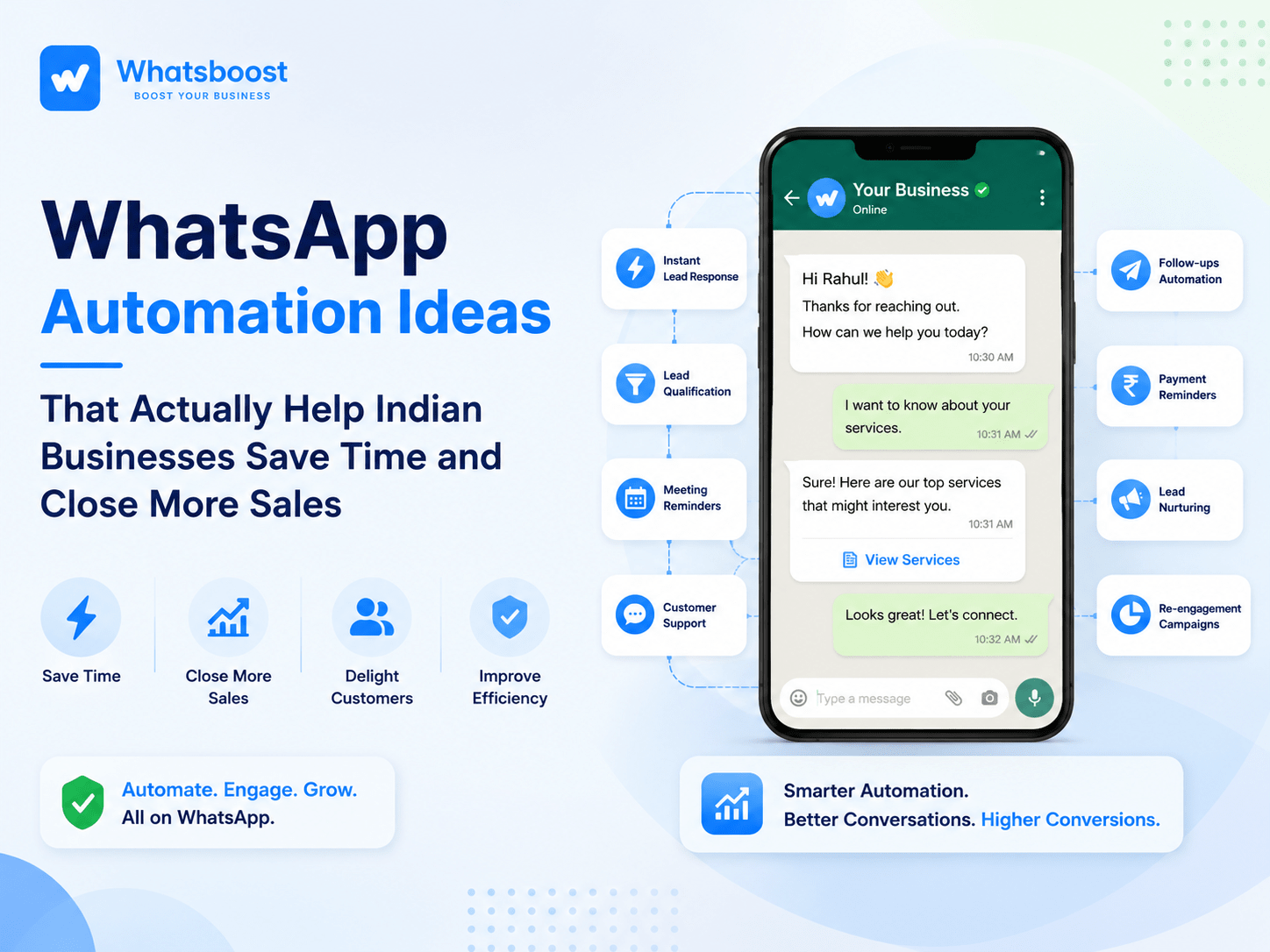
“Hi Rahul 👋 Thanks for reaching out. Our team will guide you shortly. Meanwhile, could you share what exactly you’re looking for?”
feels conversational and human.
That difference impacts engagement quality significantly.
Businesses already building conversational funnels often combine instant responses with a structured WhatsApp sales funnel that guides leads from inquiry to conversion inside one continuous conversation flow.
2. WhatsApp Automation for Lead Qualification
Many sales teams spend enormous time speaking with unqualified leads.
That creates operational exhaustion very quickly.
WhatsApp qualification workflows help businesses automatically collect important information before sales reps step in.
For example:
Budget range
Business size
Service requirement
Timeline
Product interest
Location
Industry type
This improves operational efficiency because teams can prioritize high-intent leads instead of manually screening every inquiry.
For Indian MSMEs operating with smaller sales teams, this becomes one of the highest ROI automation systems.
It also improves customer experience because qualified leads receive faster and more contextual responses.
Businesses trying to reduce lead drop-offs inside conversations often combine qualification systems with properly designed WhatsApp flows that reduce sales funnel drop-offs to improve conversion consistency.
3. Automated WhatsApp Meeting Confirmations and Reminders
Most businesses obsess over getting meetings booked.
Very few optimize what happens between booking and follow-up.
That gap causes:
No-shows
Delayed reminders
Lost follow-ups
Weak customer coordination
Modern WhatsApp workflows solve this immediately.
The moment a customer books through Calendly or another scheduler, WhatsApp can automatically trigger:
Meeting confirmations
Google Meet or Zoom links
Reminder sequences
Reschedule options
Pre-call instructions
This dramatically reduces operational coordination work.
For businesses handling demos, consultations, onboarding sessions, or discovery calls regularly, automating appointment workflows improves both customer experience and sales efficiency.
Teams using tools like Calendly increasingly rely on Calendly WhatsApp integrations to automate confirmations, reminders, and post-meeting communication without manual follow-ups.
Businesses focused heavily on appointment-based workflows also benefit from structured WhatsApp appointment reminder automation that reduces no-shows and keeps customers engaged before meetings.
4. Automated Post-Meeting Follow-Ups
The biggest revenue leak for many Indian businesses is inconsistent follow-up.
A good sales conversation happens.
Then nothing.
No summary.
No proposal.
No next step.
No structured continuation.
This is where WhatsApp automation becomes operationally powerful.
After a sales call, businesses can automatically send:
Thank-you messages
Meeting summaries
Proposal documents
Pricing sheets
Follow-up reminders
Payment instructions
This keeps momentum alive.
And momentum matters because customers rarely buy immediately after one interaction.
Most deals close through continuity.
Businesses building structured post-call systems often see significantly better follow-up consistency compared to teams relying entirely on manual coordination.
Automated follow-up sequences are especially effective for businesses handling high lead volumes from platforms like IndiaMART, where fast response speed directly affects conversions. Many businesses now use automated WhatsApp follow-up workflows for IndiaMART leads to maintain engagement without operational overload.
5. Automated Customer Support for Frequently Asked Questions
Most support teams repeatedly answer the same questions daily:
Pricing inquiries
Delivery timelines
Store timings
Refund policies
Appointment scheduling
Payment methods
Service availability
Automation helps businesses resolve these repetitive interactions instantly without overwhelming support teams.
The important part is balance.
Good support automation should:
Solve simple queries quickly
Escalate complex cases intelligently
Maintain conversational tone
Keep human support accessible
The businesses seeing the best results are not replacing support teams.
They are reducing repetitive workload so support teams can focus on higher-value interactions.
6. WhatsApp Payment Reminder Automation
Many Indian businesses still manage payment reminders manually.
That creates delays, awkwardness, and inconsistent follow-ups.
Automated payment reminder workflows help businesses send:
Invoice reminders
Subscription renewals
Pending payment notifications
EMI reminders
Order confirmation updates
Because WhatsApp messages are usually seen faster than emails, payment communication becomes quicker and more effective.
This is particularly valuable for:
Agencies
Coaching businesses
SaaS companies
Freelancers
Healthcare providers
Subscription-based businesses
7. Automated Lead Nurturing Workflows
One of the biggest misconceptions in sales is assuming every inquiry converts instantly.
Most customers need time.
Lead nurturing workflows help businesses stay visible during that consideration period without manually following up every few days.
Businesses can automate:
Educational content
Product walkthroughs
Case studies
Testimonials
Feature updates
Industry insights
This keeps conversations alive naturally.
For businesses trying to improve long-term conversion quality, structured WhatsApp nurturing workflows often perform better than aggressive sales-heavy messaging.
8. Re-Engagement Automation for Cold Leads
Many businesses spend heavily on acquiring new leads while ignoring old prospects completely.
But old leads are not always dead.
Sometimes timing was simply wrong.
Re-engagement automation helps businesses reconnect using:
New offers
Seasonal campaigns
Updated pricing
New product launches
Case studies
Follow-up reminders
This creates additional conversion opportunities without increasing acquisition costs.
Businesses with large historical inquiry databases often unlock substantial revenue simply by organizing cold lead reactivation workflows properly.
Why WhatsApp Automation Works Better Than Traditional Systems
Traditional business communication often feels fragmented.
Email for updates.
Calls for coordination.
CRM for notes.
Spreadsheets for tracking.
WhatsApp simplifies this because customers already use it daily.
That reduces behavioral friction dramatically.
Customers are more likely to:
Read messages quickly
Respond faster
Continue conversations
Ask follow-up questions
Stay engaged
This is why conversational commerce is growing rapidly across India.
Businesses that reduce operational friction generally create smoother buying experiences.
And smoother experiences convert better.
The Difference Between Smart Automation and Spam
Many businesses damage customer trust because they automate aggressively without contextual understanding.
Good automation feels timely and relevant.
Bad automation feels intrusive and repetitive.
The goal should never be:
“How many messages can we send?”
The better question is:
“How can we remove friction from the customer journey?”
Businesses that focus on operational convenience consistently outperform businesses focused only on message frequency.
How WhatsBoost Helps Businesses Build Smarter WhatsApp Automation Workflows
WhatsBoost helps Indian businesses centralize WhatsApp communication workflows without operational complexity.
Instead of managing disconnected systems manually, businesses can automate:
Lead response workflows
Qualification funnels
Appointment confirmations
Reminder sequences
Customer follow-ups
Payment reminders
Lead nurturing campaigns
Re-engagement workflows
Team coordination systems
inside one connected operational environment.
Businesses can also use WhatsBoost’s dedicated automation and follow-up workflows to create structured customer journeys that save time while improving engagement consistency.
The result is not just faster communication.
It is operational consistency at scale.
Final Thoughts
WhatsApp automation is not about replacing human relationships.
It is about removing operational inefficiencies that prevent businesses from maintaining strong relationships consistently.
Customers still want human trust.
But they also expect:
Faster replies
Better follow-ups
Smoother coordination
Organized communication
Consistent customer experience
The businesses growing fastest today are combining both:
Human conversations supported by intelligent automation systems.
That combination helps Indian businesses:
Save time
Improve operational efficiency
Reduce repetitive workload
Increase conversion consistency
Scale customer communication without chaos
Because in modern Indian business communication, operational smoothness is becoming a competitive advantage.
And WhatsApp automation is increasingly at the center of that shift.
Want to automate WhatsApp for your business?
Set up campaigns, replies, and follow-ups in minutes.